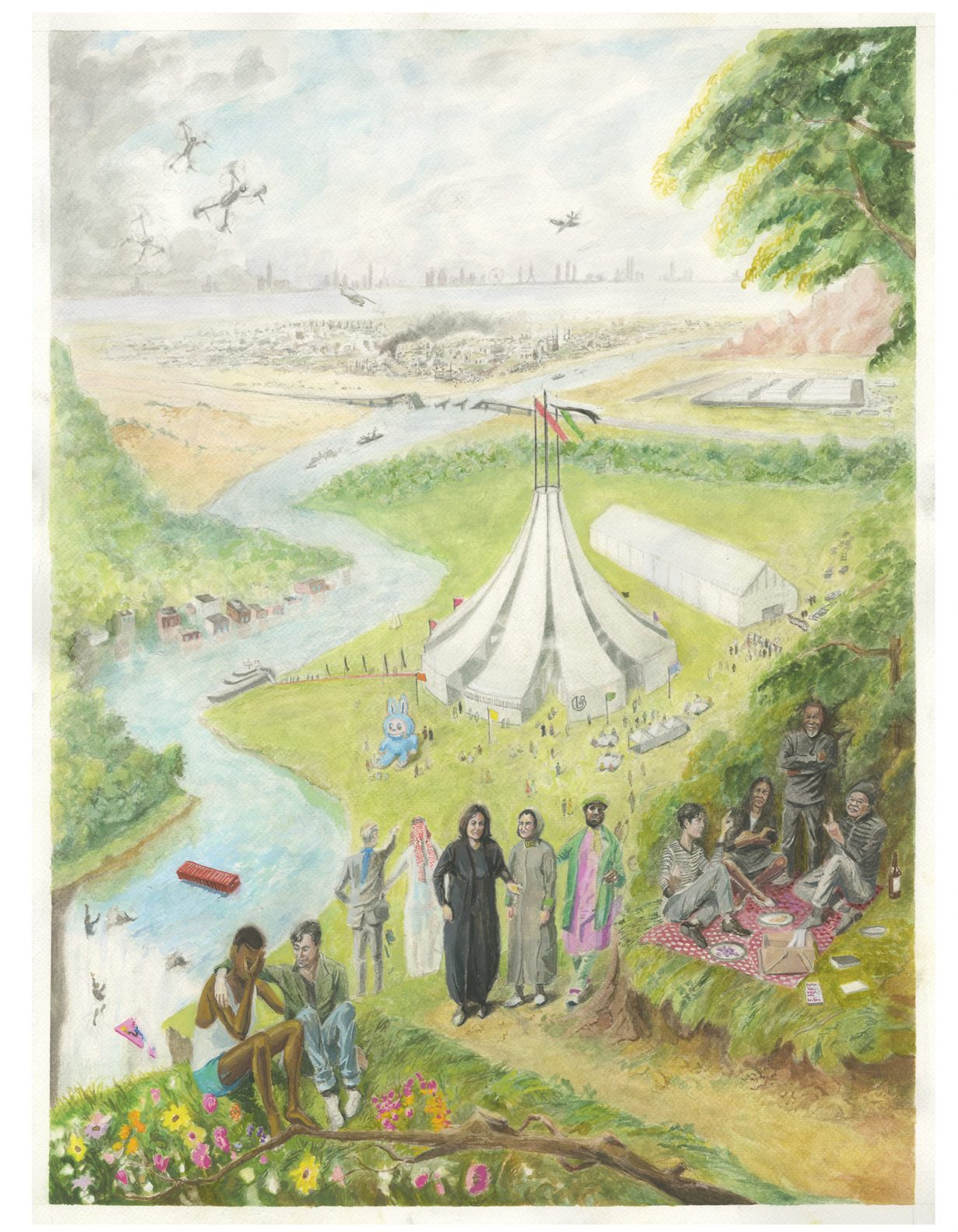
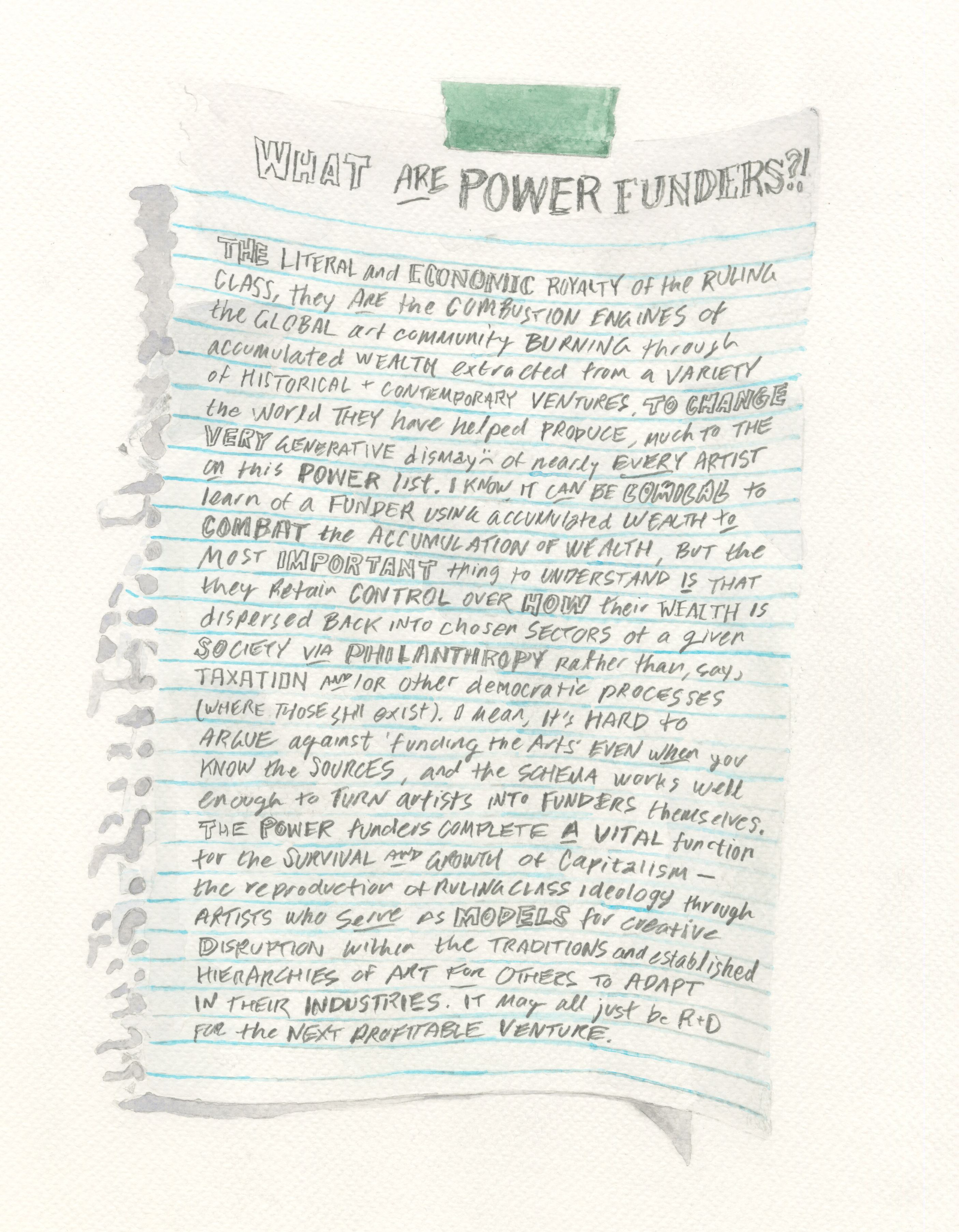
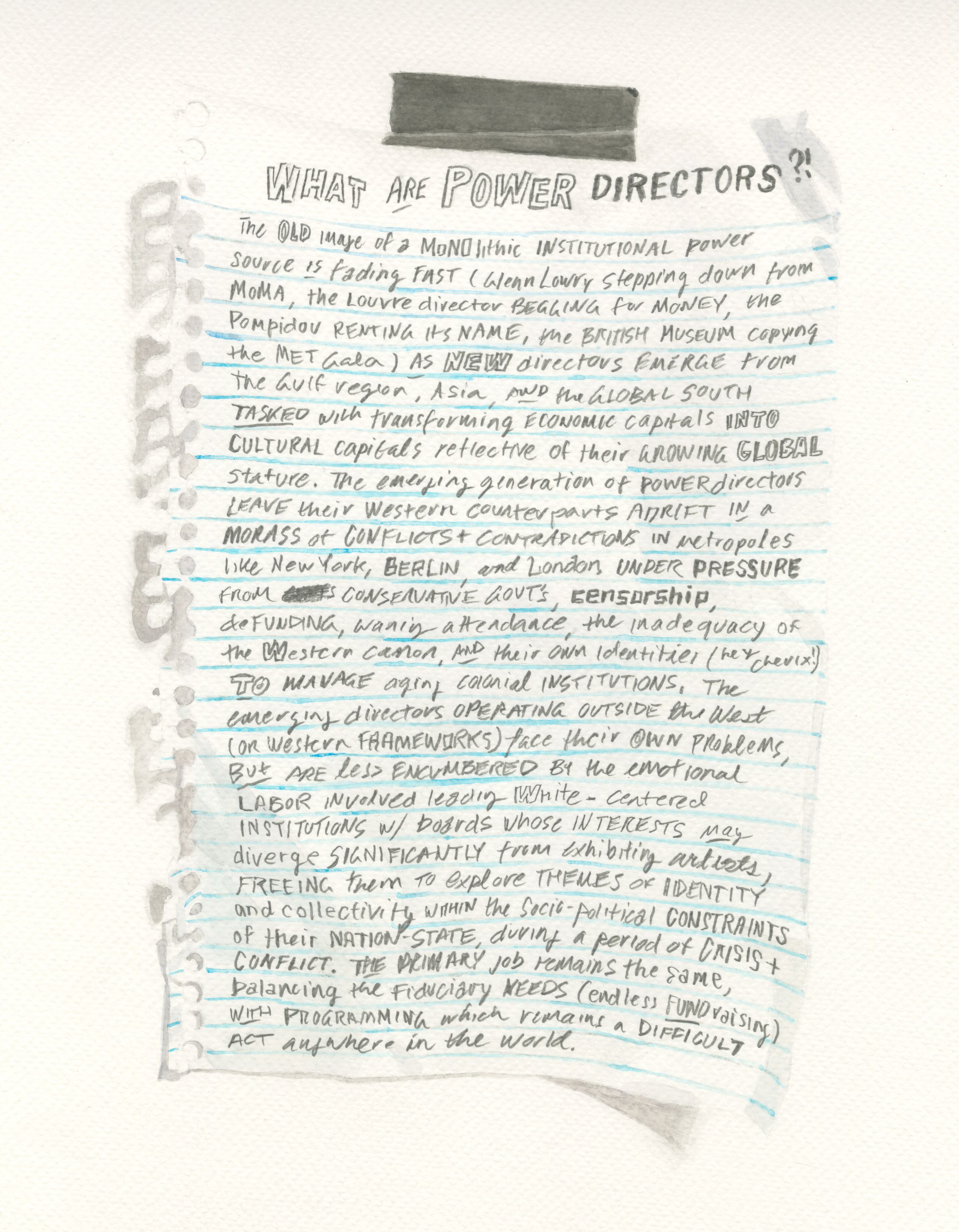
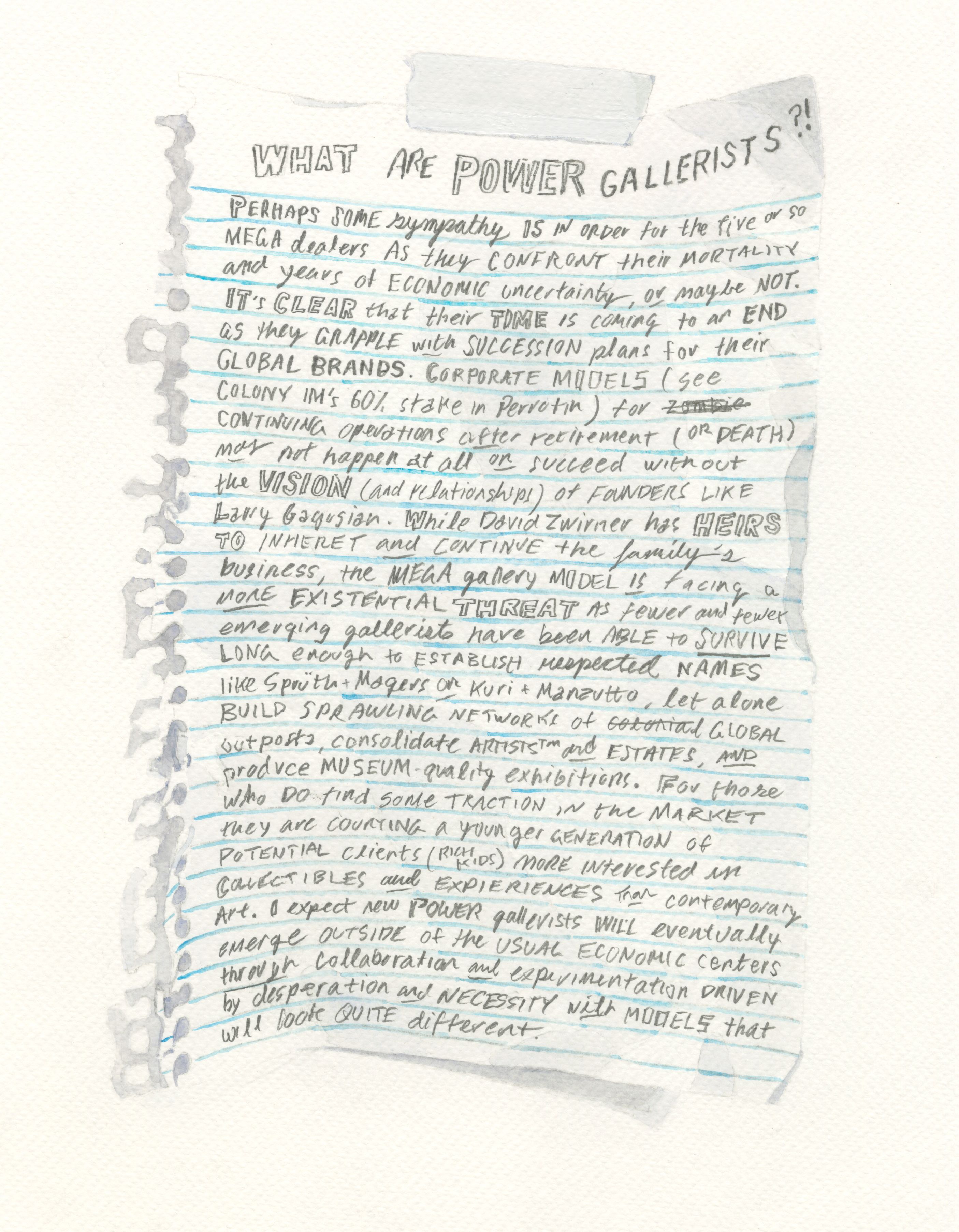
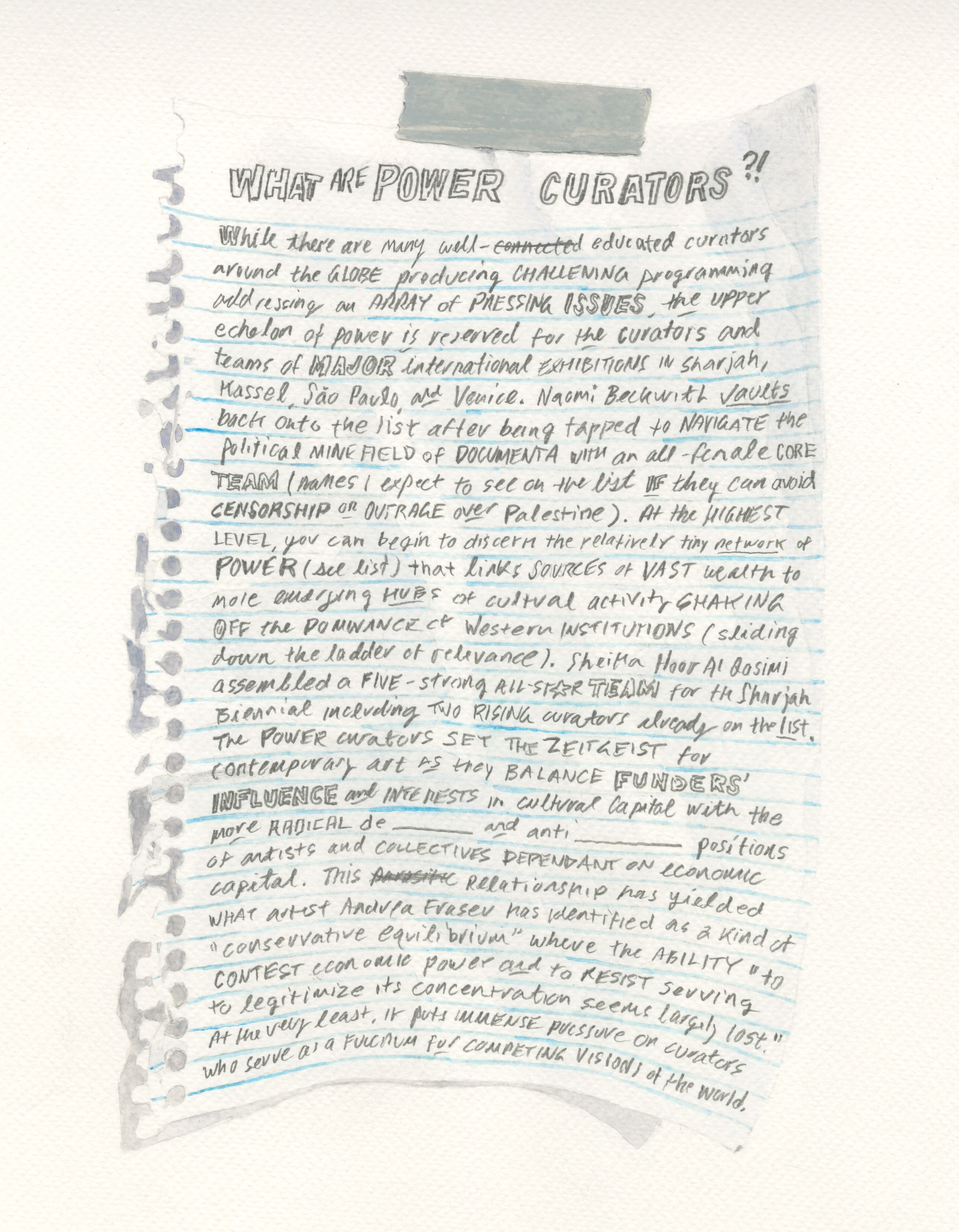
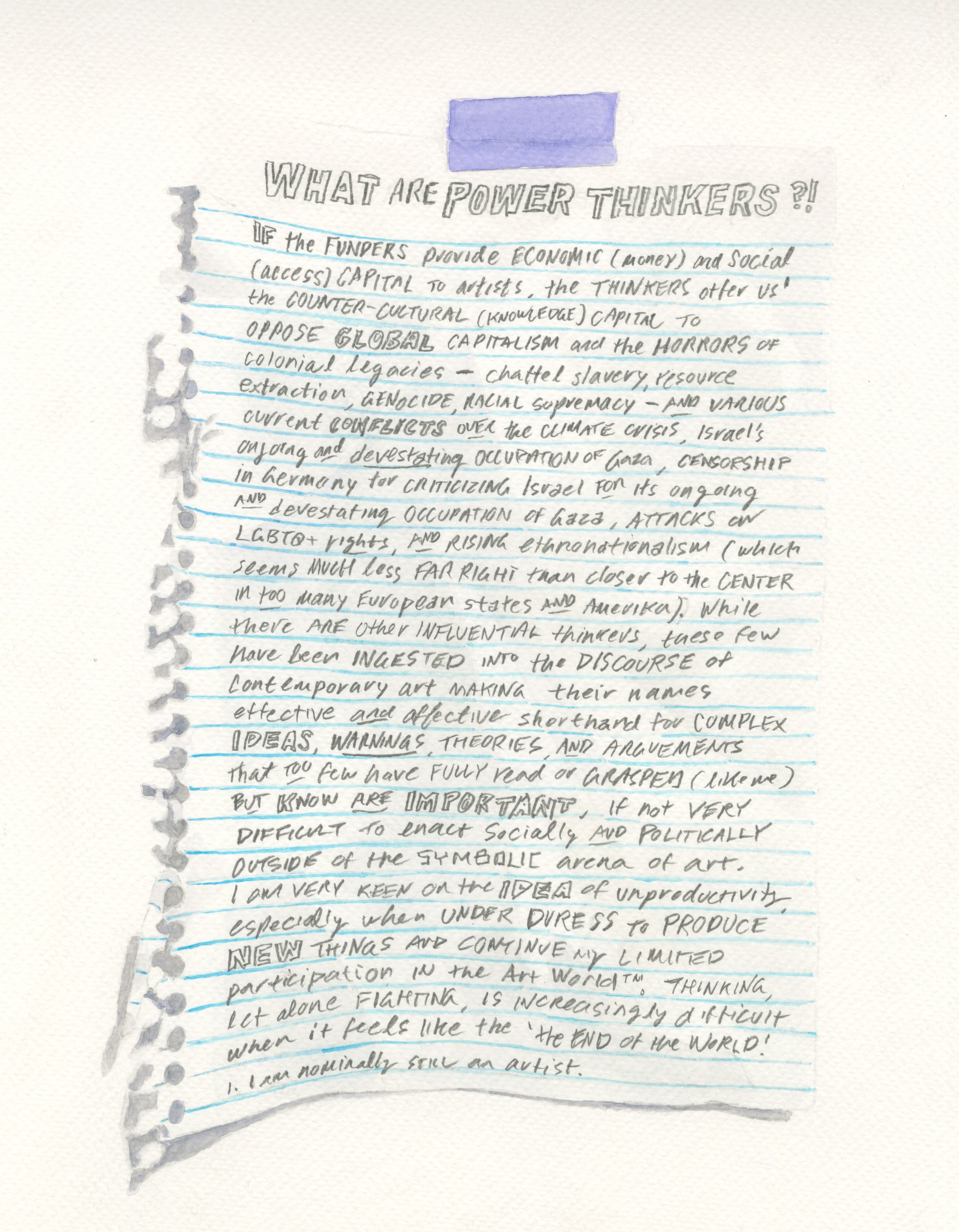
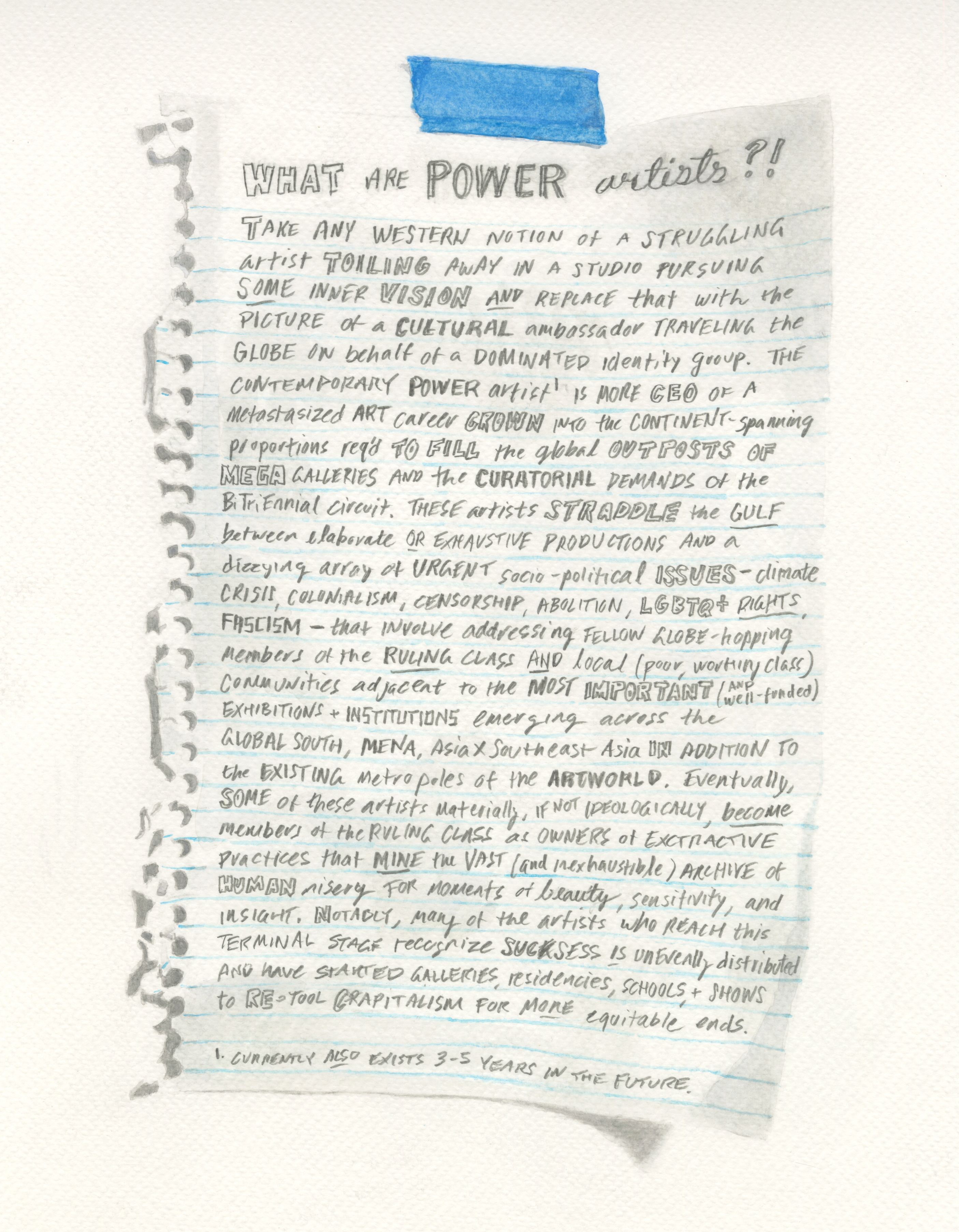
In December of last year, I painted a cover for Art Review magazine’s annual Power 100 list focusing on the role major international exhibitions played in shaping the list. It seemed heavy on the artists, curators, directors, and funders involved in the big surveys that operate in relation to the art market’s global sprawl of art fairs.
It was interesting to read Art Review’s coverage of the 2026 Biennial curated artist list, which included a brief curatorial statement, ‘‘The 61st international art exhibition of La Biennale di Venezia intends neither a litany of commentary on world events, nor an inattention or escape from compounding and continuous intersecting crises,’’ said Rory Tsapayi. ‘‘Rather, it proposes a radical reconnection with art’s natural habitat and role in society, that is the emotional, the visual, the sensory, the effective, the subjective’’.
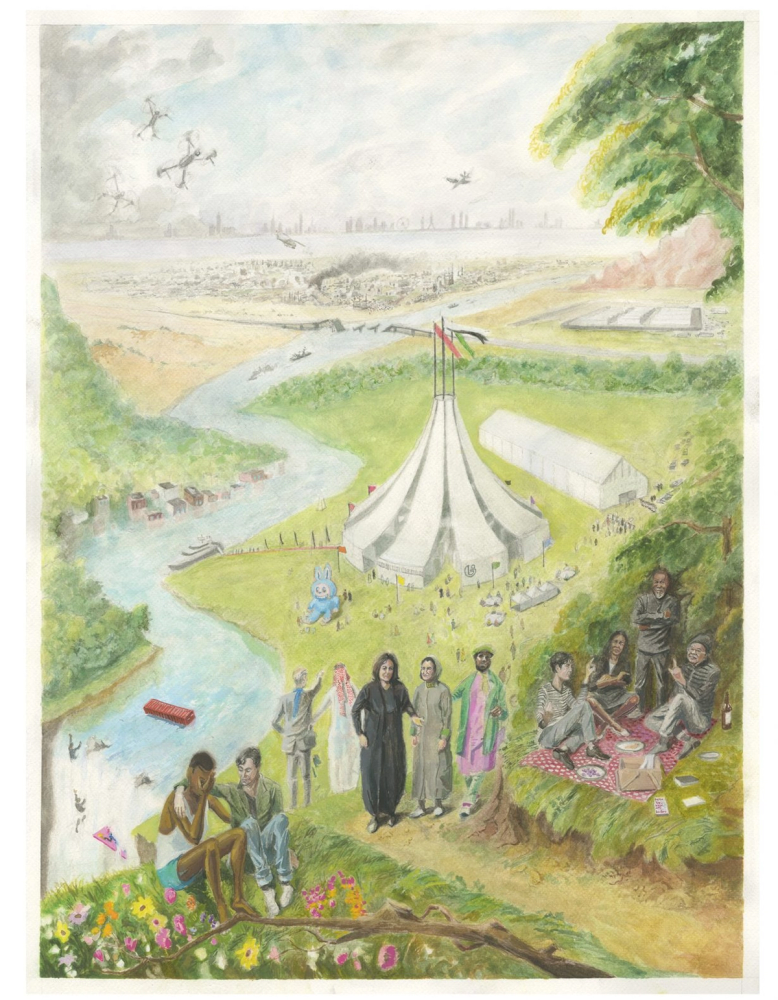
While I don’t imagine that Tsapayi is responding in any way to my cover or series of drawings that explored the kinds of power represented on the list, I enjoyed reading their aspirational definition of “art’s natural habit and role in society.” While the giant Biennial tent in my painting is indeed situated in nature, it is set far away from any particular society to reflect to the cultivated distance contemporary art maintains from any of the societies the artists and art works represent. This distance, or disinterest, extends to the conflicts taking place in the distance from war to immigration detention centers to the growing impacts of global climate change.
I appreciate the nuance in Tsapayi’s statement, which suggests that art once held a role in society, and that a “radical reconnection” is now required. In the painting, a collapsed bridge waits to be re-built, to perhaps reconnect art to the communities and people who live the countries that temporarily host this migratory art world offering the challenges and pleasures of “_the emotional, the visual, the sensory, the effective, the subjective.” _I don’t expect that one edition of La Biennale di Venezia will rebuild the bridge between contemporary art and the societies it emerges from, but I certainly appreciate how Tsapayi and their co-curators are aware of the distance between art and society. If I have the leisure time and money this year, I would like to visit Italy and explore the 61st edition, but that points to another classed definition of society.
For more about the cover and my drawings for the issue, please read my interview with Art Review editor Oliver Basciano.
Zero Art Fair is coming back for a second edition in July at The Flag Foundation in Chelsea. The second iteration of the fair is currently accepting applications during our open call until April 18th (or 400 applications are reached). We’ve built a new website for artists to register an account and submit images for our curatorial team to review. We hope to accept approximately 100 artists for the fair that will open July 8th with a 3-day preview exhibition open to the public. During that period, the works will be available for sale at the retail prices declared by the artists. We facilitate direct sales between the artist and the collector, but are not involved in the sale or take a commission, although we ask artists to consider contributing 10% of the sale to support further development of the fair. This year, we were able to create the new website with support from an individual donor who contributed funds last year.
While the fair will operate similarly to our first edition in Elizaville, but this year with the change in venue, we will be prioritizing access to the 2-day fair, July 11 - 12, to people who normally cannot afford to buy art. Visitors who would like to take home a work using our contract will have to register and tell us if they fall into one of three categories:
- I can help others afford to live with art.
- I can normally afford to purchase art.
- I need help to live with art.
This process will rely on the honor system and the fact that all collectors’ names will be listed in our public database after the fair. We hope that collectors and art lovers who have the financial means will buy art, rather than take advantage of the generosity of artists willing to let some of their inventory out in the world. This access will be progressive and proportional based on the number of visitors who request a ticket, and reflects our efforts to get the available works into the lives and homes of people who are priced out of the art market.
The 2025 edition of the fair is co-sponsored by our host, The FLAG Foundation, and Gagosian. The funding this year comes from two sources, a non-profit art space and a commercial gallery. We are grateful that we do not have to raise money this year by fundraising with our own print editions or asking for help from our community of friends and supporters. We will also not have to offer early access to work for donors of $500 or more and can prioritize access to those who need the most help. Zero Art Fair is an ongoing experiment that relies on the potential value of artwork in the market should future sales and re-sales occur. While our goal is to free art from storage and get it out into the world to be experienced, it does not assume the work has zero economic value.
I am pleased to announce Zero Art Fair is coming this July to upstate New York. The fair is an experimental model built out of the Store-to-Own project I launched back in 2020. Now, working with artist Jennifer Dalton, we have transformed that concept into an art fair where all of the work is free, but with the same strings attached so that artists can give their work away, without giving up on its value.
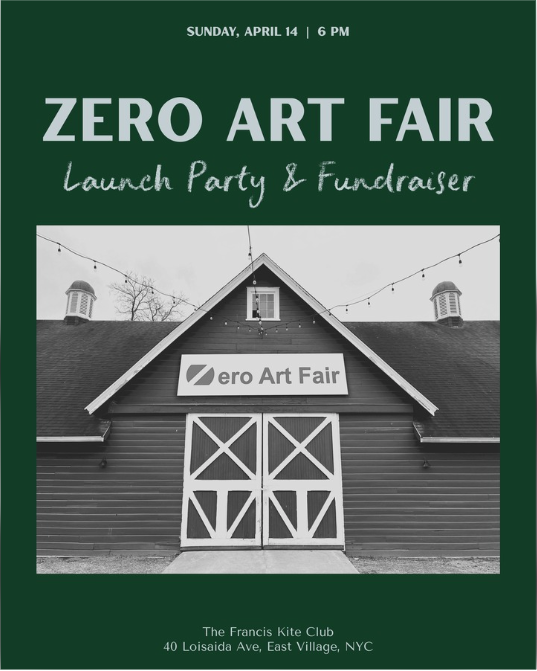
To help launch the fair and raise funds to bring it to life in Elizaville this July, we are throwing a party at The Francis Kite Club on Sunday, April 14th from 6 - 8pm. The party is free and open to the public, but we are asking people to help out by buying a ticket at one of the different tiers on offer. We are funding our project in a progressive manner, inspired in part by Mark Bittman’s idea for a progressively priced restaurant, where we acknowledge there are people who need help to live with art, people who can afford to live with art, and people that can help others live with art. We’re trying to fund Zero Art Fair the same way, so please consider contributing what you can.
At this early stage in the development of our first edition of ZAF, we are an unincorporated organization created by me and Jennifer. We are in the process of building an advisory board and a curatorial committee for the fair. We want to pay people who help us make the fair happen, and eventually, if possible, pay ourselves something for the hundreds of hours that we have contributed, but that’s after we’ve covered all of our expenses. This all means that we are not a non-profit 501c3 and we don’t have fiscal sponsorship, so contributions to the fair are not tax deductible. Currently, contributions will be handled through Donorbox and the Stripe payment system under my LLC, Powhida Art. If the fair is a success and moves forward, we will pursue one of those options to formalize our commitment to remaining a not-for-profit project. We aren’t here to make a profit off the work of the artists who are willing to take part in an experiment with us, to see if there are other ways of valuing art.
We hope you’ll join us Sunday, April 14th, to learn more about Zero Art Fair. We’ll be joining Manon Slome (founder of No Longer Empty) and Laura Hanna (The Francis Kite Club and Debt Collective) to talk about the fair and other models for art and community, including how to fund them without giving up accessibility and openness. In the sprit of the Kite, we’ll also be in conversation with artists and collectors in the audience about their own experience with re/sales, inventory, storage, and trades.
Event Info here: https://www.franciskiteclub.com/#/events/102165
If you’re already interested in participating as an artist or collector, please take a moment and fill out our interest survey on our website. If you’d like to get involved in other ways, partnership, sponsorship, or just lending a hand, please email us at zeroartfair@gmail.com and we’ll be in touch.
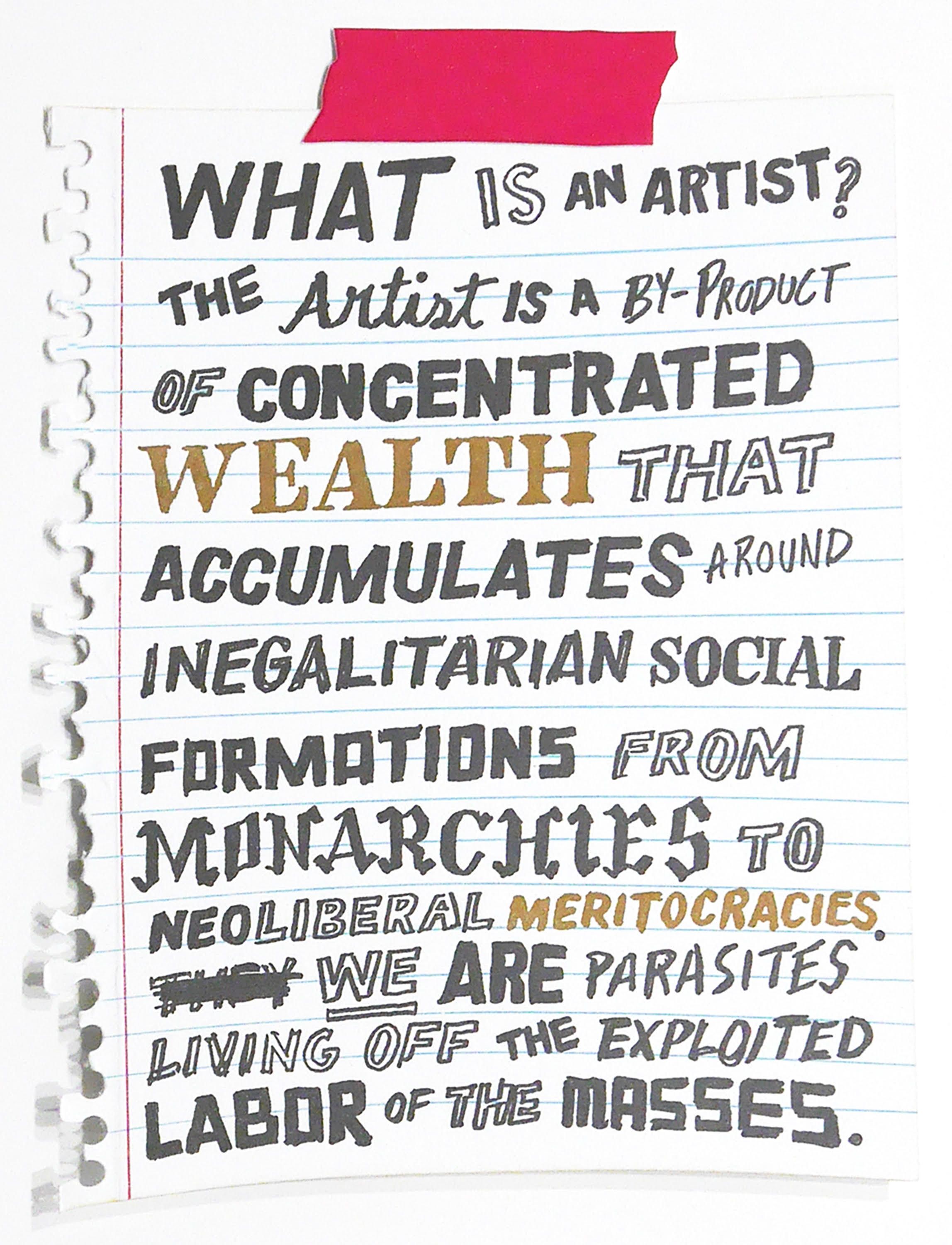
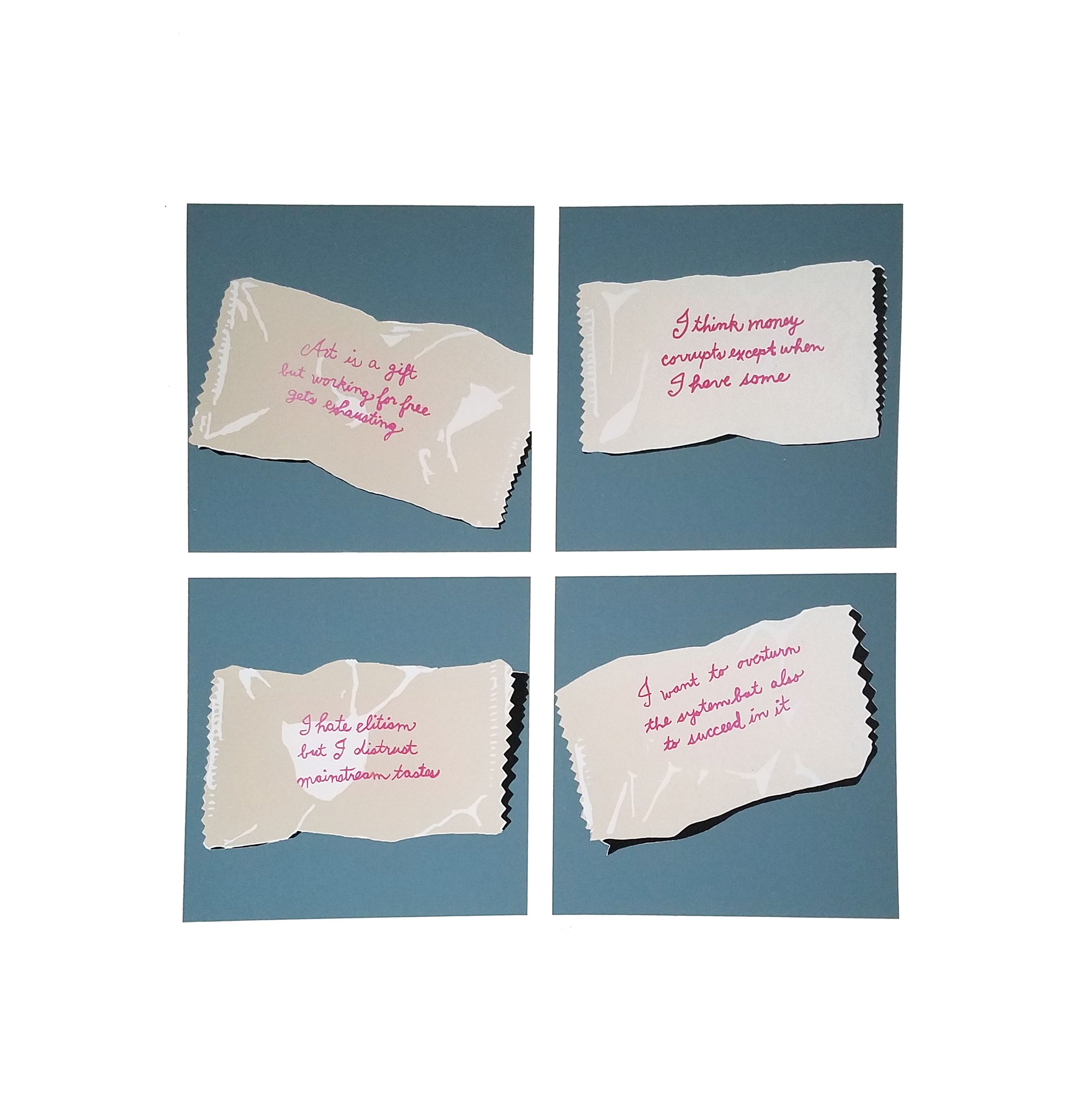
Prints available through the fundraiser:
William Powhida
What is an Artist? (2017)
Letterpress
16 x 20 inches
Jennifer Dalton
Artist’s Candy (2015)
Silkscreen
27 x 27 inches
It’s the fall art season and that means heading out to openings and events where I run into other artists who ask “What have you been up to?” Generally, I want to say “Nothing! I have zero coming up and don’t really care, because I can barely stand to think about making art.” Of course, I don’t say this because it would be very awkward, and I am still making work, just not for a particular exhibition. For the past several months one of the main things I’ve been working on in fits and starts has been editing a feature length experimental film about my curatorial project Shaoul+Howe that I hope will be finished and debut this year. I’ve had the pleasure of working the film’s director, Guy Richards Smit, and the main editor, Jason Cacioppo to develop the film. It’s been a long time since I’ve edited video, and we’re putting it together from footage shot over 3 months during the run of Shaoul+Howe at 601 Artspace.
This year, I’ve also made a few new drawings for exhibition, and two of the most recent works will be included in a works on paper show at Bert Green Fine Art in Chicago that opens October 14th and runs through December 29th. If you happen to be in Chicago, Bert’s gallery is open on Fridays from 12 - 4pm by appointment Monday through Friday. I’m also currently exhibiting the drawing “Koch Industries (Private Company)” from my 2019 exhibition, Complicities, at Montclair State University Galleries as part of Jesse Firestone’s exhibition The Backend. I’ll be speaking at Montclair on November 9th at 6pm with professor Dr. Ethne Swartz about the business of art.
But back to the other questions artists ask with a mixture of judgment and curiosity “Do you have anything coming up?” I do! I am collaborating again with the wonderful artist Jennifer Dalton to transform my Store-to-Own project into a full-fledged art fair. We’re busy planning and developing the inaugural edition of Zero Art Fair, or 0AF, for next summer’s Upstate Art Weekend. The experimental fair will use my Store-to-Own contract, generously developed by Amy Whitaker and Alfred Steiner, to allow artists to give away previously exhibited works or works they’ve had in inventory for over 5 years, without giving up on its potential market value. Artists who use the contract to give works to collectors retain rights to 50% of any future sale price, and are granted a 10% resale royalty in perpetuity. This is not for newly made works and the fair is not a substitute for selling work. It’s a way to get unsold inventory out of storage and into homes for works that have already had a chance in the market. We understand that the high prices of art are maintained by the careful control of available inventory that perpetuates the myth of scarcity when we know art is one of the least scarce things in the world.
If you’re interested in learning more about Zero Art Fair, get in touch with me. If you interested in supporting the development of the fair, even better.
Images:
Advice to Artists
Graphite and gouache on paper mounted on panel
20 x 16”
2023
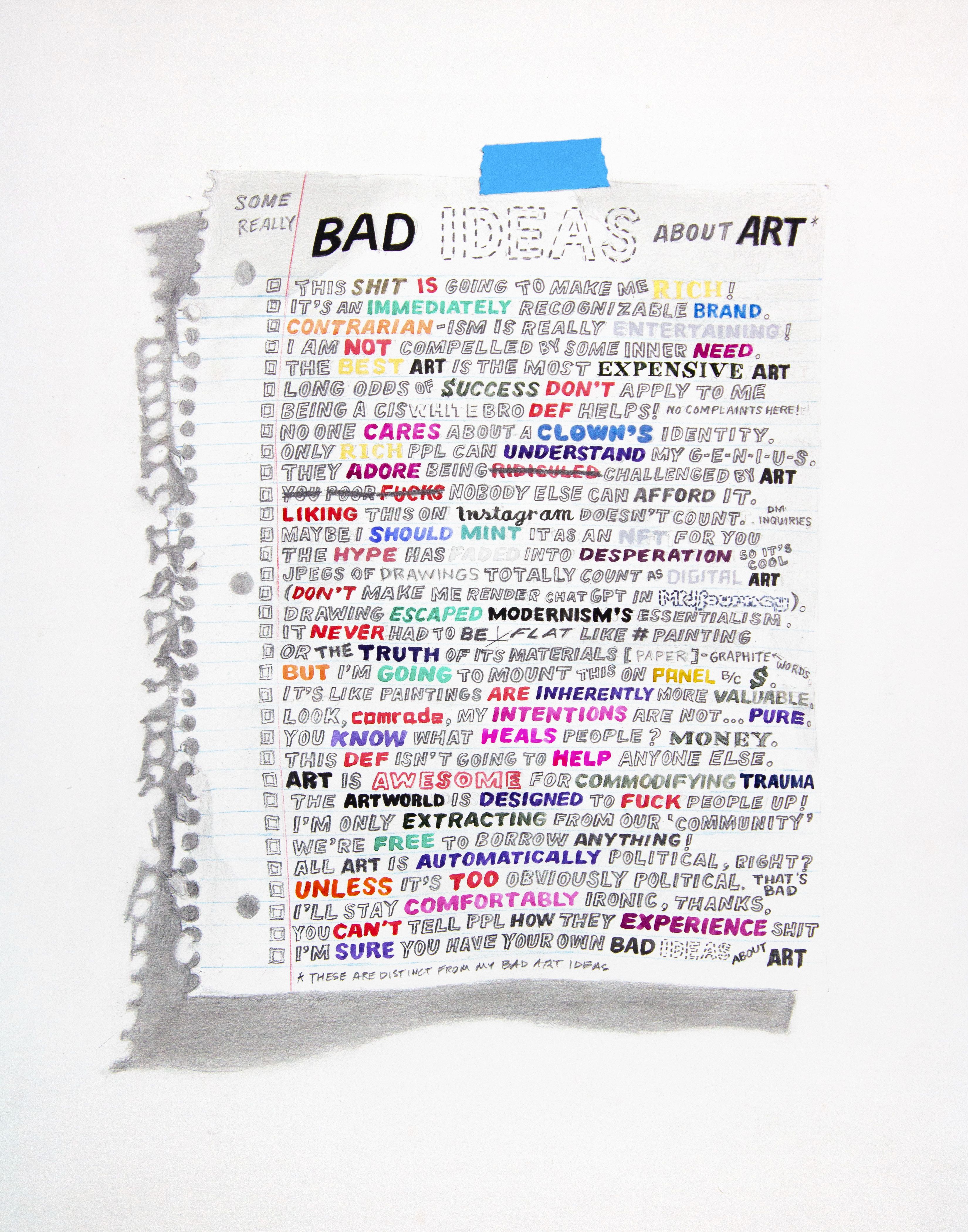
Bad Ideas About Art
Graphite, watercolor, gouache, and colored pencil on paper mounted on panel
20 x 16”
2023
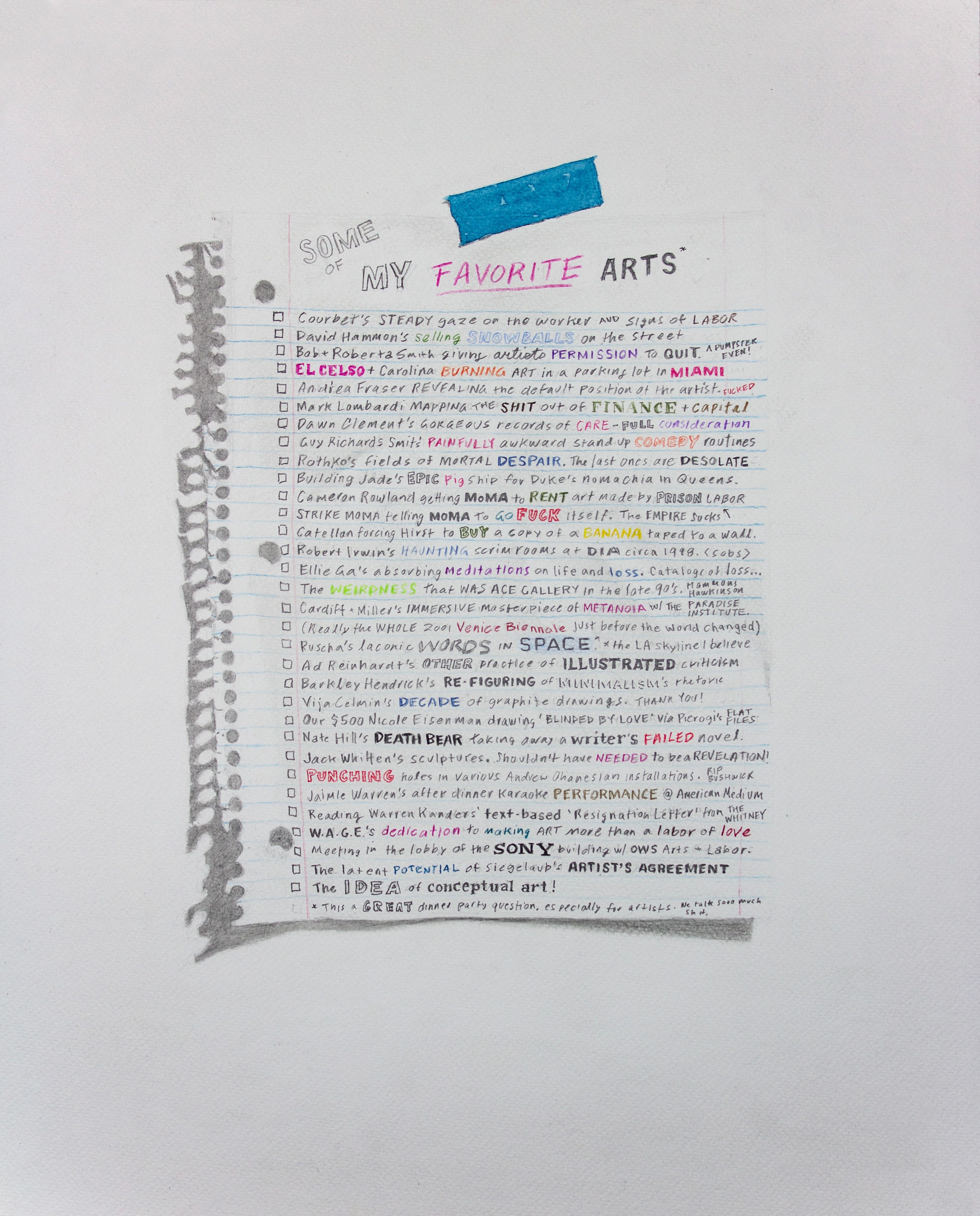
Some of My Favorite Arts
Graphite, watercolor, gouache, and colored pencil on paper mounted on panel
20 x 16”
2023
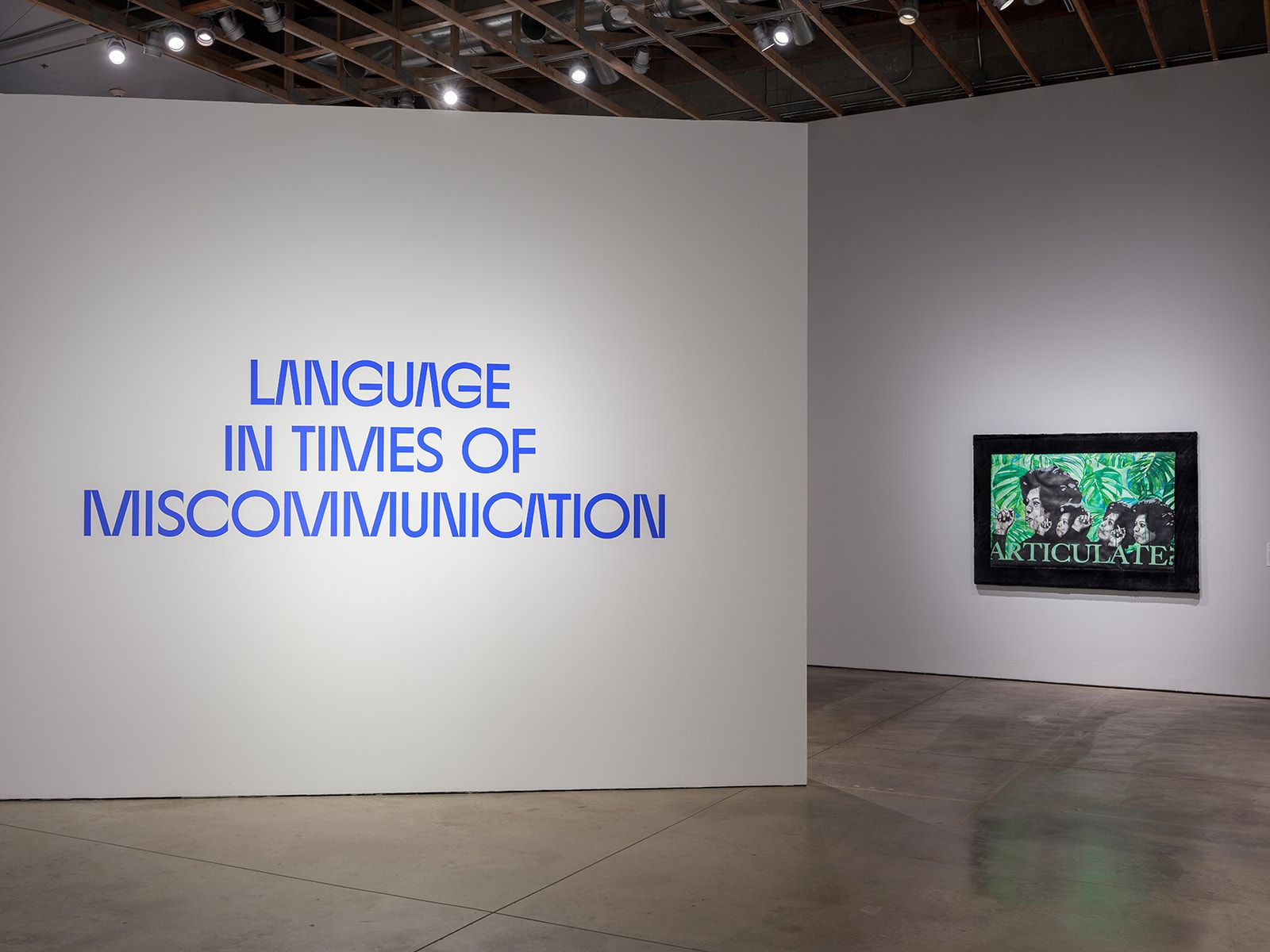
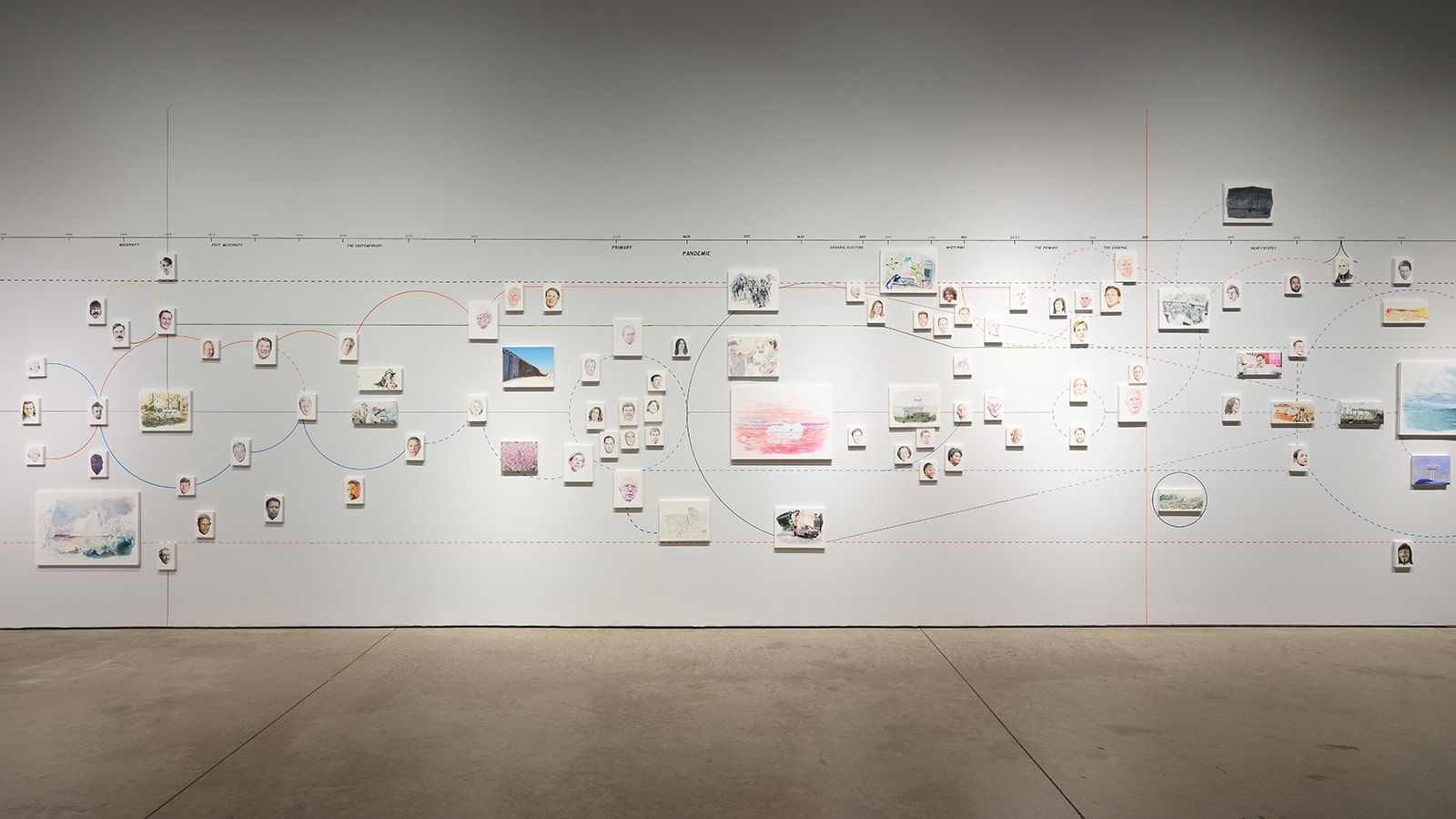
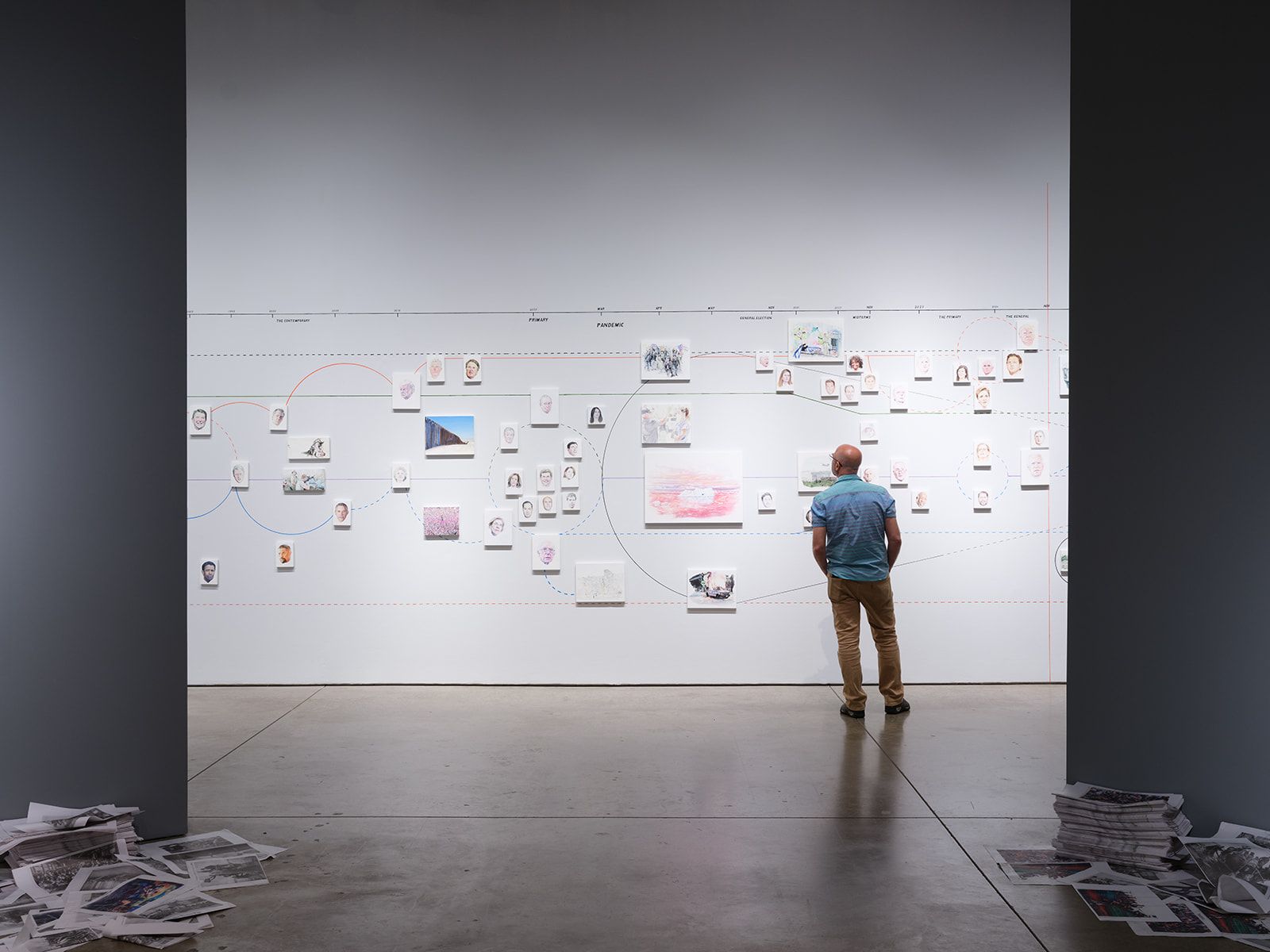
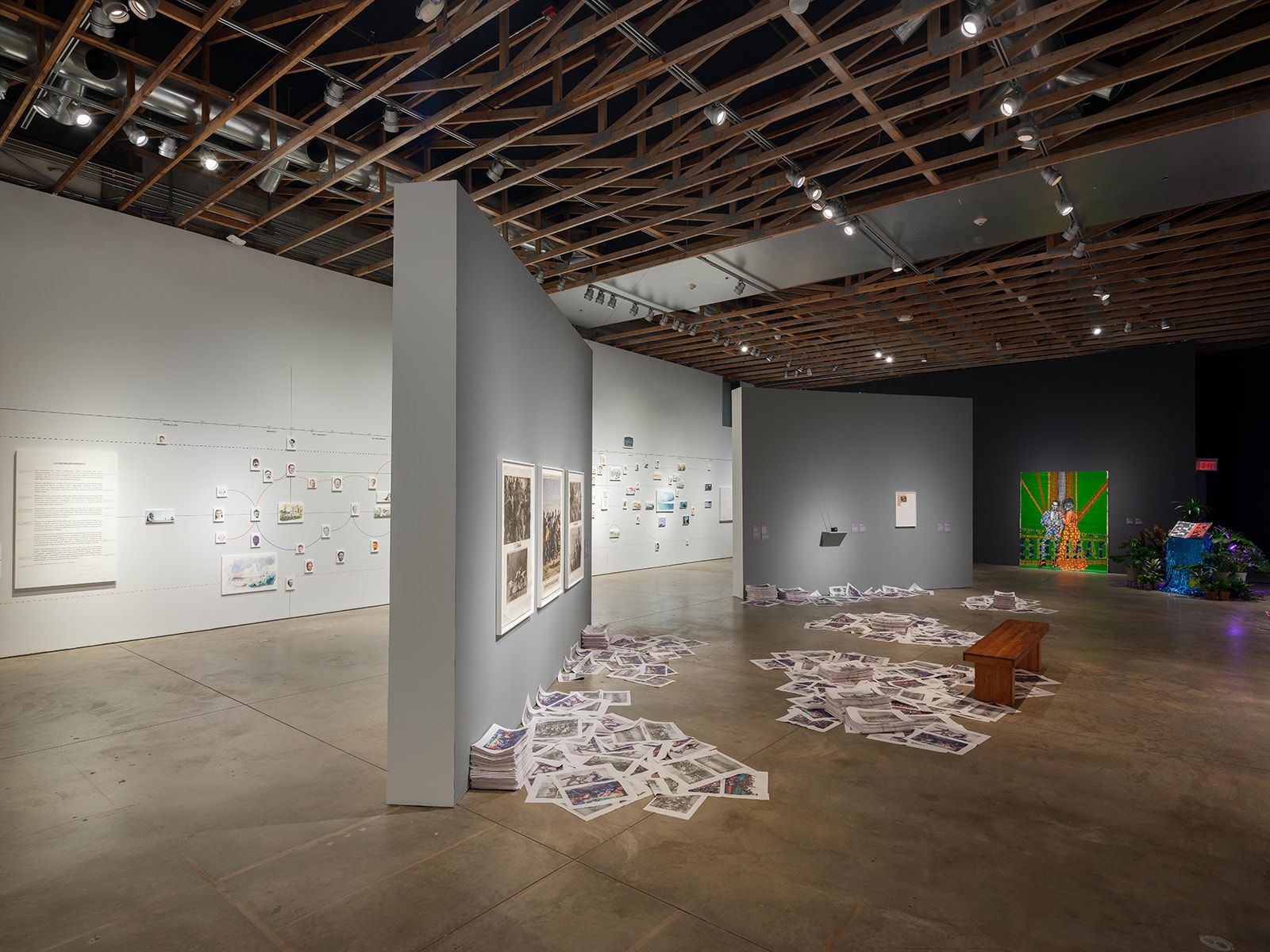
Language in Times of Miscommunication opened March 4th at the Scottsdale Museum of Contemporary art. The show is curated by Lauren O’Connell, the museum’s curator of contemporary art, with the support of Kesha Turley. The exhibition includes the most recent iteration of my installation, Possibilities for Representation, that I began work on over three years ago. It spans a period of time that includes a pandemic and Joe Biden’s defeat of Donald Trump in the 2020 election.
The exhibition brings together the work of 18 artists whose work addresses the role perception plays in the reception of information. It’s an ambitious show that pushes back against dismissive labels like ‘political art’ with a range of works that engage subjectivity and how viewers or audiences may construct meaning, perhaps differently than intended by any individual author. The speed with which words, phrases, and are coopted and appropriated by the right highlights the mutability of language to function as a political symbol.
The show was recently reviewed by Lynn Trimble for Hyperallergic who observed “William Powhida’s “Possibilities for Representation” (2020–ongoing), an expansive watercolor and gouache installation comprising a timeline of the United States’ political history and several imagined futures, speaks to the existence of propaganda across time with an elegant mix of history and humor, conveyed in part through images culled from the overlapping realms of politics and pop culture.”
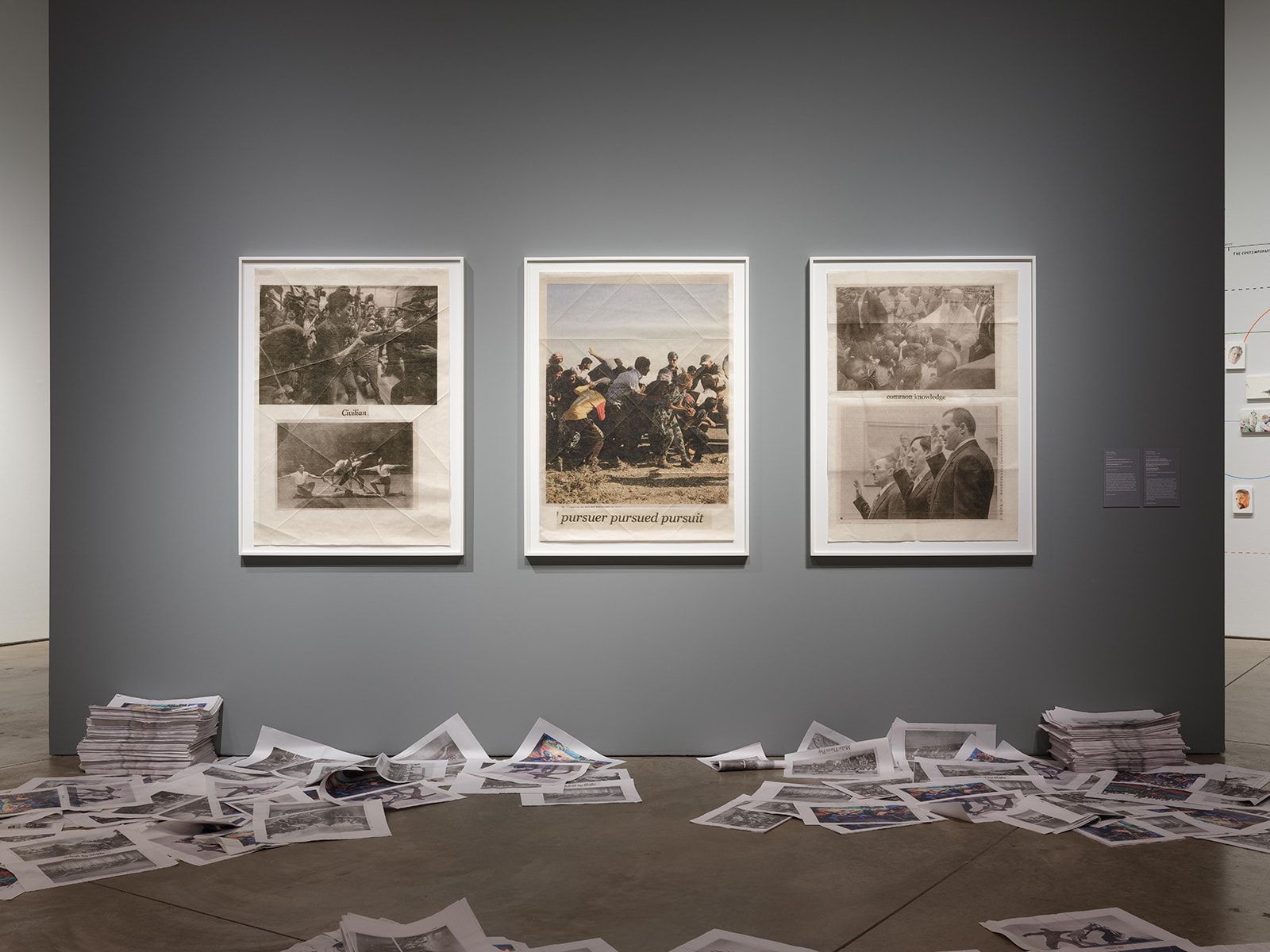
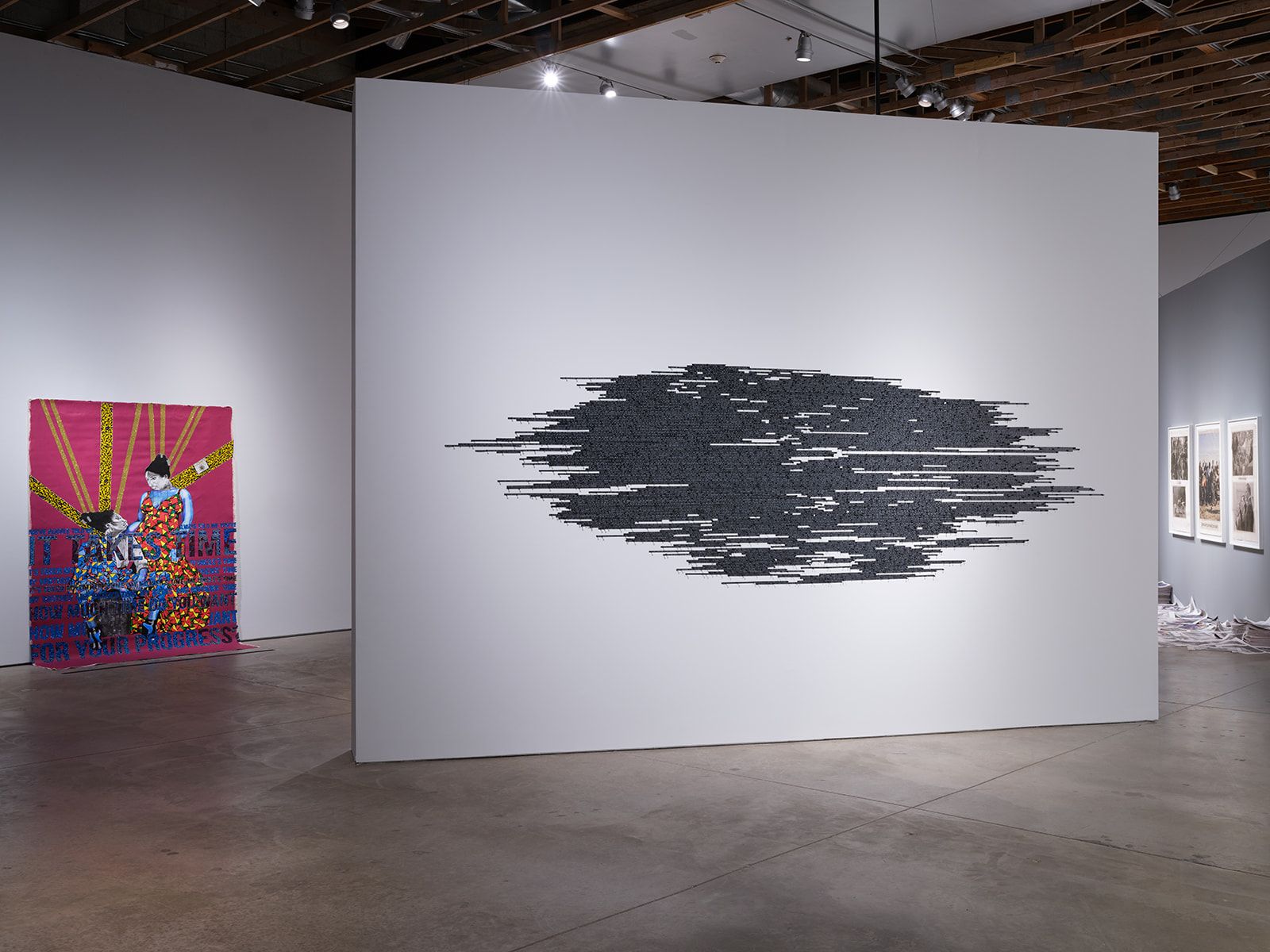
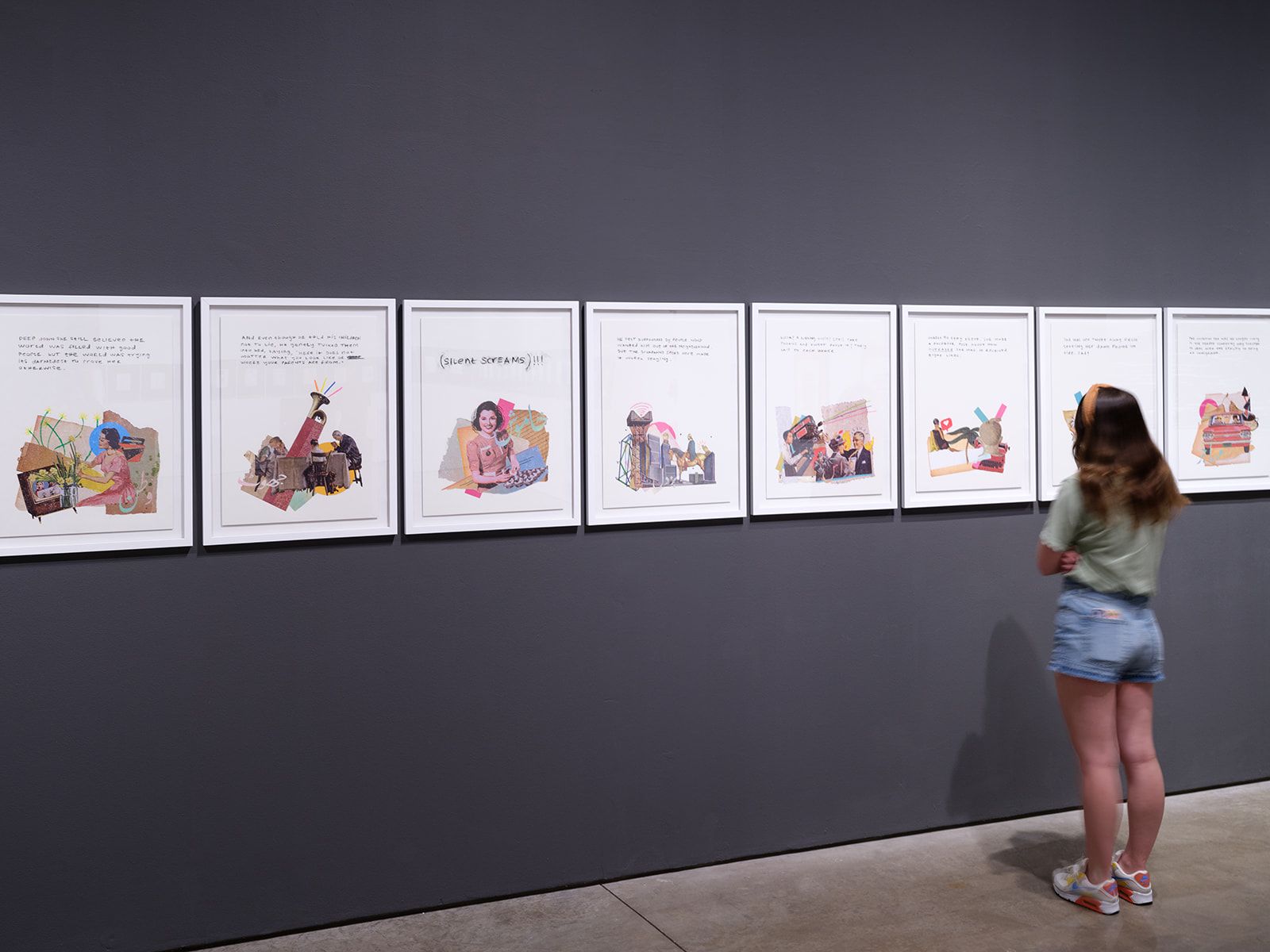
My installation shares a gallery with York Chang, Christopher Jagmin, April Bey, Jenny Holzer, and Safwat Saleem among the artists included in the exhibition. If you are in the area this excellent group show is currently on view in Scottsdale, AZ until August 27th and well worth a visit. A catalog is currently available for pre-order and curator Lauren O’Connell has written an extensive and insightful essay that provides far more context for all the artists’ work.
I’m grateful to Lauren O’Connell and the museum for providing me the space and time to produce the latest version of Possibilities. Further documentation of all of the paintings included in the installation will be available soon. This is an exhibition that I would love to see travel in 2024 as we enter another election cycle in times of constant and intentional miscommunication.
Installation views of Language in Times of Miscommunication at Scottsdale Museum of Contemporary Art (SMoCA), March 4 – August 27, 2023. Photo: David Blakeman
Pictured: William Powhida’s Possibilities for Representation (Variation 6), York Chang’s Factograph Series, Christopher Jagmin’s I Will Sleep Tonight (center) and April Bey’s Your Progress (left). Safwat Saleem’s Concerned but Powerless #1 - #22